
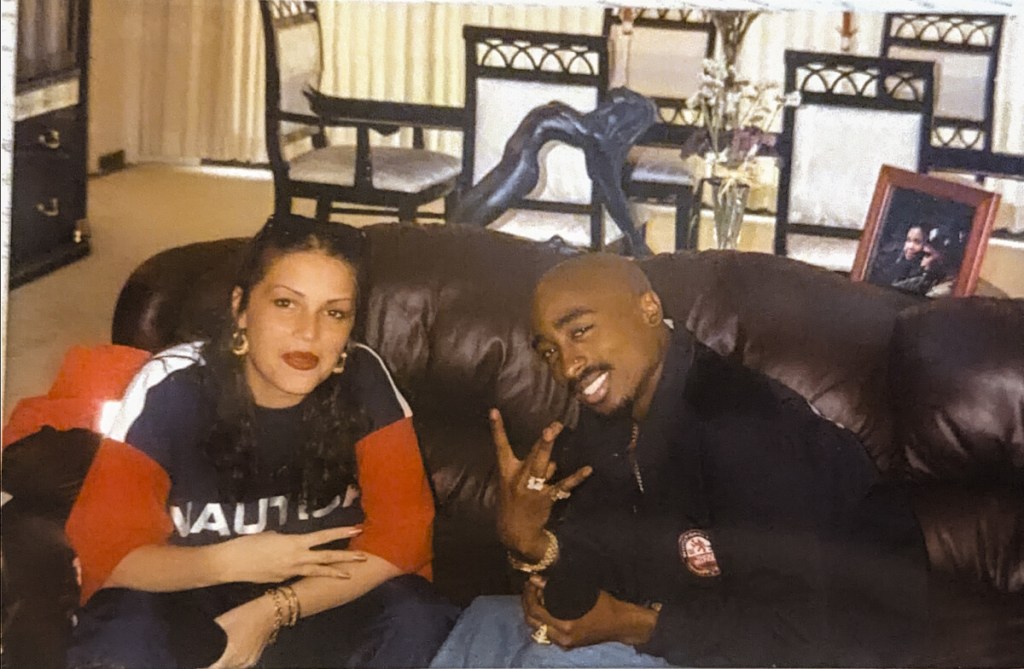
Weeks before “Hit ’Em Up” dropped, Tupac invited a New York radio host into his home. Thirty years later, what he wanted her listeners to understand is still getting lost in the argument.
Tupac had New York pizza waiting for Angie Martinez when she got to his house in Los Angeles. A funny choice for a man New Yorkers were supposed to believe hated them. Funnier still was how she ended up there. Pac had asked Martinez to appear in his “I Ain’t Mad at Cha” video. She turned him down. Things were tense enough back home that even a cameo felt like picking a side. Then he told her something she thought her listeners deserved to hear. He had problems with people in New York. How had the whole city ended up in it?
That last part is worth sitting with. Before Martinez ever picked up a microphone, the East Coast–West Coast story had already made a decision for her. A young woman who played hip-hop on New York radio had to think about what it would mean to stand next to a rapper in a music video. If you want to understand how big this thing had gotten by 1996, start there.
Listen to the way Pac talks about Mobb Deep. What we hear is a man looking for the most humiliating thing he can say about two other men. The sexual language is part of how the insult works. And yes, people are going to hear that differently in 2026. But imagine being on the receiving end in 1996. The whole point was for it to sting then, too.
What caught us on the rewatch was Angie asking who he meant by “they.” It’s the kind of follow-up that sounds almost too simple until you try answering it. Mobb Deep is a specific answer. New York is a city full of people, including the woman sitting across from him. How often have we let one stand in for the other?
Audio excerpt from Netflix’s The Tupac Tapes with Angie Martinez. Contains profanity.
In the interview, Pac calls the idea of a war between the coasts “corny.” Coming from almost anybody else, that might have passed without much comment. Coming from the man who gave us “Hit ’Em Up,” it practically invites an argument. And Pac has to own his part in that. You can name the people you’re angry with on a record. You get considerably less say over who feels disrespected when it comes through the speakers. New York listeners had ears. They had every reason to take him seriously.
But taking Pac seriously ought to include listening when he explains himself. Somewhere in the retelling, Biggie became shorthand for New York, Pac became shorthand for the West, and millions of people who had never had a cross word with either man got drafted onto teams. Who decided a fan in Brooklyn had to hand in their Tupac records? And why, thirty years later, do we still tell the story as though everybody agreed to those terms?
Martinez made a choice that complicates the popular version of this story. New York did hear some of that interview. She aired portions in which Pac explained where he stood and held back remarks she believed could make a dangerous situation worse. She remembers sitting at the station with a razor blade, physically cutting the tape. Years later, she was still thinking about which questions she might have pushed harder. She was also the person on the radio who had to tell those listeners that Pac had died. That history earns her decision a little more consideration than the easy verdict that she should have just pressed play.
It also leaves us with a more uncomfortable question. If Angie aired Pac’s point about New York and the feud is still the part we remember best, how much would playing the rest really have changed? We’re making that same editorial decision now. The Mobb Deep remark fits neatly into a short clip. Pac’s frustration at being misunderstood takes longer to explain. Which one do we expect people to share? A diss record travels well. You can put it on at a party thirty years later and somebody knows exactly when to come in. An explanation given to a radio host asks people to sit still, hear somebody out and maybe reconsider a story they enjoy telling. That’s a tougher sell. It was a tougher sell then, too.
Netflix’s four-part The Tupac Tapes with Angie Martinez, which premiered November 27, lets us hear the interview in the company of people with their own memories of that era. Martinez brings in voices including RZA, Big Boy, dream hampton and Joe Budden. The pleasure of watching is in having a reaction of your own while somebody else is still working through theirs. You can hear why Pac felt misunderstood and still think he knew exactly what he was doing on that record. There’s room for both in the same living room.
Watch the official Netflix trailer
The series arrives the same day Pac’s Life turns up in record stores as a 20th-anniversary double LP. For some listeners, the Pac they met first was the voice alongside Ashanti and T.I. on the title track, a decade after his death. Now those same listeners can hear him across from a young Angie Martinez, still alive, still angry, still trying to get a point across to people back east.
Maybe the part we got wrong was deciding that “Hit ’Em Up” settled the question of how Tupac felt about New York. His words about Mobb Deep tell us how personal the anger could get. Listeners who think he crossed a line have a case. The leap worth questioning is how an insult aimed at two men became evidence against a whole city. For the rest, consider whom he called in May. When Pac wanted New York to hear him out, he knew exactly who to invite over.

