
There are two ways to pay for a car repair. One household pulls the money from savings and goes back to work on Monday. Another puts it on a credit card and pays for that same repair for months. Both got their car back. Only one is still paying interest when the next bill arrives.
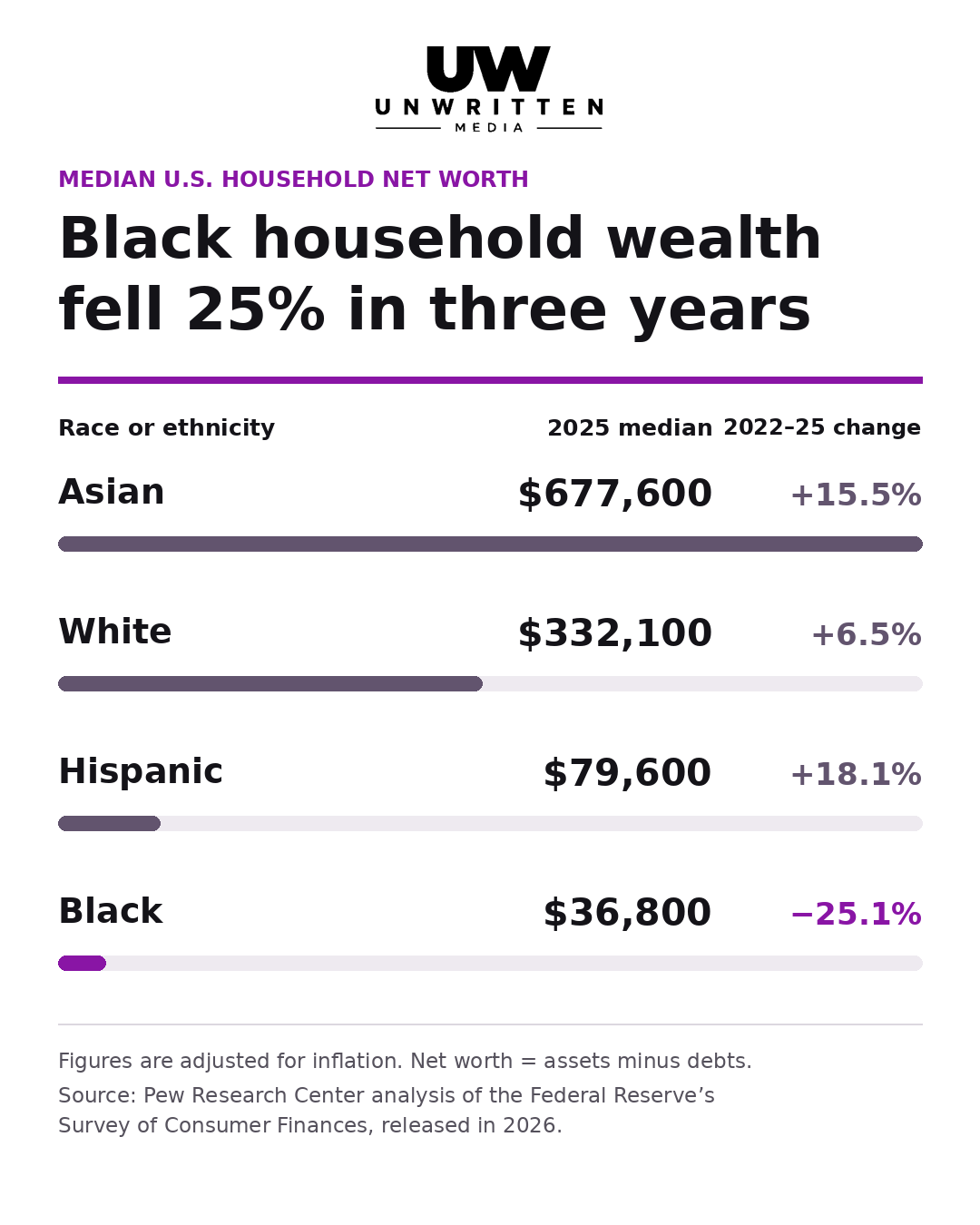
That difference is what a paycheck alone leaves out. And it’s why the latest Federal Reserve numbers on Black household wealth deserve more attention than a screenshot can give them. The median fell from $49,100 in 2022 to $36,800 in 2025, adjusted for inflation. That’s about a quarter of the previous figure gone in three years. Over the same period, the national median increased about 2% to $215,900.
A recovery can look different depending on what you own
The median is the midpoint. Half of households in a group fall below it and half are above it. The Fed’s survey compares snapshots from two years, so the $12,300 difference describes a change in that midpoint. It doesn’t track a particular family’s losses. In fact, average Black family wealth rose about 5% over the same period. A household with substantial assets can pull the average up even if the midpoint moves down. Both numbers belong in the story because they answer different questions.
There’s another detail worth getting right. In 2019, the comparable median for Black households was $30,600. It climbed to $49,100 in 2022 and then fell to $36,800. The 2025 figure is still above the pre-pandemic level in inflation-adjusted dollars. What’s striking is how much of the gain disappeared while the median for White, Hispanic and Asian households kept rising. White median wealth was about nine times Black median wealth in 2025, the widest ratio in the Fed’s survey since 2016.
Who was in a position to benefit?
Across the country, the Fed found that median home equity rose among homeowners between surveys. It also found that among households with stock holdings, the median value of those holdings increased even as the share of households with stocks edged down. Those details matter. If you rent, a rise in the value of the home you live in builds equity for the owner. If your paycheck is already spoken for, a strong stock market can come and go without changing what you have available in an emergency.
Getting into a home is one decision. Being able to stay through a job loss, a steep insurance increase or an expensive repair is another. A down payment can depend on whether a parent is able to help. Keeping the house can depend on whether you have cash left after closing. And when homes appreciate, how much wealth an owner can put to work still depends on what they owe.
None of those mechanisms tells us exactly how much of the 2022–2025 drop came from housing, debt or investments. Answering that takes more analysis than a national table can provide. What the survey does give us is a reason to ask who was able to buy assets early enough to benefit from rising values, and who had to borrow just to keep up with the cost of living.
What gets passed down before anyone inherits a house
We tend to picture inherited wealth as a transfer after someone dies. It can show up decades earlier. A parent pays a security deposit. A grandparent covers a semester of tuition. Someone in the family has room for you to move in while you save. Even a relatively modest gift can let one person keep contributing to retirement while someone earning the same salary has to pause.
That’s where the conversation about financial literacy gets too narrow. Two people can know exactly how compound interest works and still end up on opposite sides of it. One earns interest on money they can leave alone. The other pays interest on money they had to borrow. Both understand the math. They had different choices when the bill came.
What would progress look like in a place like Newark?
The numbers here are national. They don’t tell us how much wealth a household in Newark lost or gained. What they do give us are questions we can ask close to home. How many first-time buyers can actually use the assistance advertised to them? How many still own their homes five years later? When a family already owns a home, can they get affordable financing for the work it needs? And what kind of savings can a renter build after paying for housing and everything else?
Those are different measures from counting mortgage approvals or celebrating a rise in home prices. They ask how much of the gain people get to keep.
The next time a national report says households are wealthier, ask whose balance sheet improved. Then ask how much of that improvement they’ll have left when the next bill comes.
Data source: Federal Reserve, 2025 Survey of Consumer Finances, released October 2026. The racial categories Black, White and Asian exclude Hispanic respondents. Featured photo: Jerrye & Roy Klotz, M.D. via Wikimedia Commons, CC BY-SA 4.0.


